If you’re thinking about buying a piano, starting your studies, or you’re simply curious, you’ve probably asked yourself: how many keys does a grand piano have?
Although the answer seems simple, behind that number there is history, technique, and acoustic reasoning that explain why modern pianos are the way they are.
At Jorquera Pianos, with nearly two centuries dedicated to repairing, restoring, and preparing concert pianos, we know every detail of the instrument. That’s why, in this guide, we explain not only how many keys a grand piano has, but also why, how this standard evolved, and what it means for you as a musician or student.
How many keys does a grand piano have, and why is this number the standard?
The exact number and how it was established
A modern grand piano has 88 keys.
This number includes:
- 52 white keys
- 36 black keys
With a range that goes from A0 (the lowest note) to C8 (the highest note).
Why do most modern pianos keep this configuration?
Because the 88 notes cover virtually the entire range a pianist needs, both for classical and contemporary repertoire.
It is a universal standard adopted by all major brands: Steinway, Essex, Kawai, Bösendorfer, etc.
From 85 to 88 keys: the historical evolution of the grand piano
Early pianos and their limited range
The first pianos created by Cristofori at the beginning of the 18th century had far fewer keys (around 49).
Over time, composers demanded wider low and high registers.
How and why today’s 88 keys were reached
During the 18th and 19th centuries, brands such as Steinway gradually expanded the range until reaching the current 88 keys.
This made it possible to perform more complex works with greater tonal richness, in line with the needs of composers such as Beethoven, Chopin, and Liszt.
What’s the difference between white and black keys? Function and structure
Chromatic layout and keyboard logic
White keys represent the natural notes: C, D, E, F, G, A, and B.
Black keys represent the altered notes: sharps and flats.
How this affects technique and learning
The design facilitates visual and tactile orientation.
Beginners rely on the groups of two and three black keys to locate notes quickly, while advanced pianists use them to execute chromatic passages and complex chords.
Why do grand pianos have 88 keys, but some special models have more?
Pianos with 97 keys and other rarities
Brands such as Bösendorfer have built pianos with 92, 94, or even 97 keys, extending the range into the lower register.
Do they really add value, or are they just a curiosity?
They are highly specialized instruments, designed for very specific repertoire.
For 99% of pianists, 88 keys are more than enough.
Grand piano vs. upright piano: keyboard differences beyond the number of keys
Feel and mechanical response
In a grand piano, the action is more precise thanks to gravity and the quality of its components, allowing for:
- Faster note repetition
- Greater dynamic control
- Better expressiveness
Dynamics, volume, and control
Although both may have 88 keys, the playing experience is very different.
The grand piano offers a wider tonal palette and superior control, ideal for advanced students and professionals.
Do digital pianos have the same keys? What you should know before buying
61, 73, and 88-key digital pianos: what each is for
- 61 keys: enough for absolute beginners, but limited.
- 73 keys: a mid-range option for modern repertoire.
- 88 keys: essential if you study seriously or follow a classical method.
Why we recommend 88 keys for serious study
At Jorquera Pianos, we’re very clear:
If the goal is to progress, the ideal choice is a full 88-key keyboard with weighted action.
Otherwise, your learning will be limited.
The importance of proper technical setup in a grand piano: beyond the number of keys
Regulation, tuning, and voicing of the keyboard
A piano—even a new one—arrives from the factory “green”:
it requires regulation, precise tuning, and voicing to balance its sound.
At Jorquera Pianos, we voice each piano according to the pianist’s preferences.
How a well-adjusted keyboard improves musical expression
A properly prepared keyboard allows you to:
- Play with less effort
- Achieve richer nuances
- Avoid frustration
- Develop correct technique
This is one of the key differences between a “normal” piano and a piano that truly inspires.
Want to try different keyboards? How we advise you at Jorquera Pianos
Real hands-on testing of grand and upright pianos in our showroom
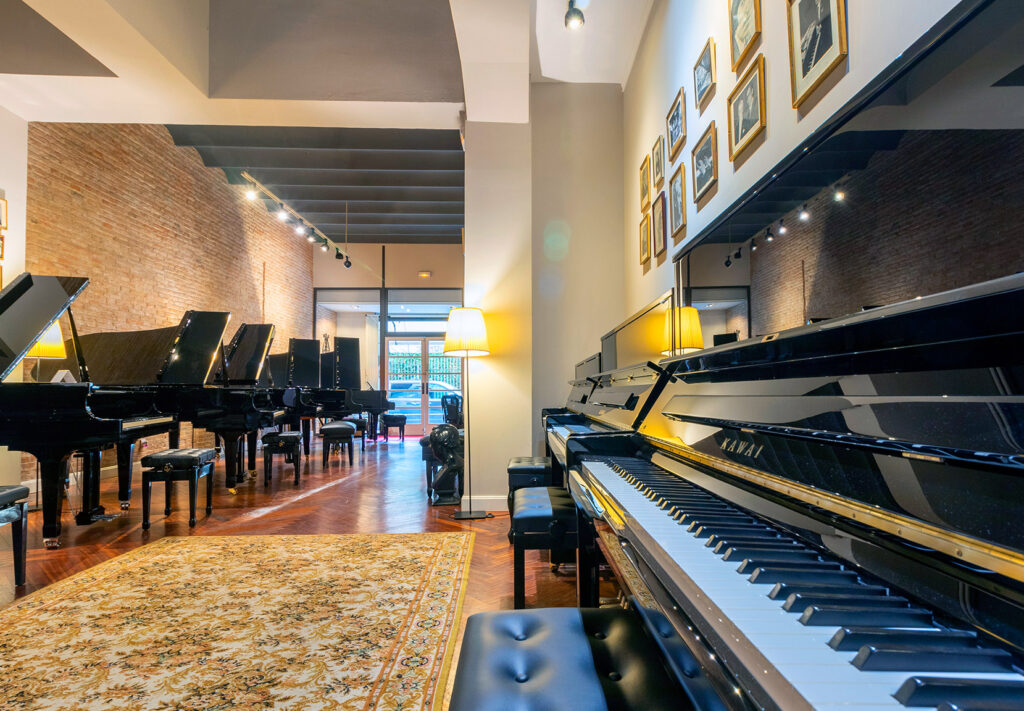
In our showroom, you can play grand, upright, and digital pianos to feel the real differences between actions and keyboards.
Technical guidance and recommendations based on your level
Our team advises you based on:
- Your level
- Your budget
- Your available space
- Your musical project
Because choosing a piano isn’t just about the number of keys… it’s about finding the instrument you’ll enjoy every day.
Want to feel the difference between different keyboards?
At Jorquera Pianos, we help you try, compare, and choose the ideal instrument according to your level, style, and budget.
Our technicians will guide you so you can discover how a good piano should respond and which model best suits the way you play.
Visit us in our showroom or contact us for a personalized consultation.
Your next piano is waiting for you.
Frequently Asked Questions about How Many Keys a Grand Piano Has
Why do modern pianos have exactly 88 keys and not more or fewer?
The 88-key standard was established because it covers the full frequency range a pianist needs, from very deep bass notes to bright highs. Expanding it does not bring significant benefits for most repertoire or study, while reducing it would limit what can be played. That’s why brands such as Steinway, Kawai, or Yamaha maintain 88 keys as the universal reference.
How does the number of keys affect the type of music I can play?
Having 88 keys allows you to play any classical, modern, or jazz piece without technical limitations. With fewer keys (such as 61 or 73-key digital pianos), some works cannot be played in full or require adaptations. For studying with a teacher or progressing seriously, a full keyboard is always the best option.
Are digital pianos with fewer than 88 keys suitable for learning?
They can be useful for getting started, but if the goal is to learn properly, a digital piano with 88 keys and weighted action is recommended. This ensures the student develops real strength, control, and technique. At Jorquera, we often see students quickly move from a basic digital piano to a more complete one because they notice limitations within the first few months.
Why do some pianos have more than 88 keys, and what are they for?
Some brands have created models with 92, 94, or even 97 keys to extend the lower range, designed for very specific repertoire or to provide additional resonance. However, these are uncommon instruments: an amateur or student pianist does not need more than 88 keys to enjoy the instrument or progress technically.
How does technical adjustment affect the feel of the keyboard even if the number of keys is the same?
Two pianos may both have 88 keys… yet feel completely different.
Tuning, regulation, and voicing affect:
- Keyboard smoothness
- Mechanical precision
- Expressiveness
- Dynamic control
At Jorquera Pianos, we adjust every instrument to ensure the pianist feels a uniform and comfortable response, whether it’s a study piano or a concert grand piano.