Understanding a piano is easier when you know the vocabulary. This glossary gathers 100 piano terms explained simply, from the internal mechanism to playing technique, so you know exactly what is being discussed when you buy, tune, or simply enjoy the instrument.
The terms are grouped by categories. If you are looking for something specific, use the table of contents to jump directly to it. And if you are still undecided between formats, start with our guide on piano types.
Piano parts
The components that make up the instrument, from the outer cabinet to the structure that holds the string tension.
- Soundboard
- A wooden board, usually made of spruce, that amplifies the strings’ vibration and gives body to the sound. It is one of the components that most influences tonal quality.
- Frame (Cast Iron Plate)
- The cast iron structure that withstands the immense combined tension of all strings and provides tuning stability.
- Bridge
- A wooden piece that transfers string vibrations to the soundboard. Its placement directly affects the piano’s timbre.
- Pinblock
- A laminated wood block where the tuning pins are set. It must hold them firmly so the piano stays in tune.
- Tuning pin
- The metal pin around which each string is coiled; turning it adjusts the tension and, consequently, the pitch.
- Strings
- Steel wires, wound with copper in the bass section, that vibrate to produce sound. Treble notes usually have multiple strings per key.
- Overstrung (Cross-strung)
- A design where bass strings cross diagonally over the middle strings. This allows for longer strings in a smaller space and improves bass tone.
- Case or cabinet
- The wooden outer structure that houses and protects the mechanism, defining much of the instrument’s aesthetics.
- Lid
- The hinged top cover; when open, it projects and increases the sound volume, especially on grand pianos.
- Backposts (Beams)
- Wooden reinforcements glued beneath the soundboard that distribute vibration and provide rigidity.
- Back frame
- The rear structure of an upright piano that supports the soundboard and cast iron plate.
- Keyboard
- The complete set of keys. The modern standard is around 88, though some models may have a few more or less.
- Keys
- Covered wooden levers pressed by the pianist. White and black keys correspond to natural and altered notes.
- Fallboard
- The folding cover that protects the keyboard when the piano is not in use.
- Music desk
- The stand where sheet music is placed.
- Pedal lyre
- On a grand piano, the structure suspended beneath the keyboard that holds the pedals.
- Casters
- Small wheels located under the piano’s legs to help move the instrument.
- Serial number
- A manufacturer’s code that, alongside the model, helps date the piano and trace its origins.
- Bench
- A height-adjustable seat designed for proper playing posture. Height impacts both technique and comfort.
Mechanics and action
The complex system of parts that translates a finger’s movement into a precise strike on the string. The piano’s sensitivity depends on its quality.
- Action (Mechanism)
- The complex system of parts that transfers the key’s movement to the hammer. Its quality dictates the piano’s touch and sensitivity.
- Hammer
- A felt-covered wooden piece that strikes the string when a key is pressed. Its hardness directly affects the timbre.
- Damper
- A felt-lined block that stops the string’s vibration when the key is released, cutting off the sound.
- Double escapement
- A grand piano mechanism allowing rapid note repetition without fully releasing the key. Invented by Sébastien Érard.
- Escapement (Let-off)
- The moment the hammer releases to strike the string freely, preventing it from blocking against the string.
- Counterweights (Key leads)
- Lead weights inserted into the keys to balance touch weight and refine the playing feel.
- Hammer butt / Knuckle
- A felt or leather-covered pad attached to the hammer shank, which the escapement pushes against to propel the hammer.
- Felt
- Compressed wool used in hammers, dampers, and many friction points. It cushions parts and shapes the sound.
- Wippen
- The hinged assembly that articulates movement between the key and the hammer.
- Hammer head
- The part of the hammer that strikes the string. With use, the felt develops grooves and needs reshaping.
- Action regulation
- Mechanical adjustments (travel, tolerances, let-off) made to the action so every key responds with uniform sensitivity and precision.
- Graded hammer action
- A system in digital pianos that mimics the varying weight of an acoustic keyboard, heavier in the bass than in the treble.
Strings, soundboard, and sound
How the sound of the piano is born and enriched, and why two instruments playing the same note never sound exactly identical.
- Chorus (Unison)
- A group of two or three strings tuned to exactly the same frequency that sound together when a single key is struck.
- Wound string
- A steel core string wrapped in copper wire, used in the bass section to increase mass and depth without excessive length.
- Pitch standard
- The tuning reference. Today, middle A is typically set around 440 Hz, with slight variations depending on country or orchestra.
- Resonance
- The sympathetic vibration of strings and the soundboard that enriches and prolongs the tone.
- Harmonics (Overtones)
- Secondary frequencies that accompany the fundamental note and add color to the tone.
- Timbre (Tone color)
- The distinct character of a sound; what makes one piano sound different from another even when playing the same note.
- Projection
- The piano’s ability to fill a space with sound. It increases with the size of the instrument.
- Sustain
- The duration a note continues to ring after striking the key, which can be extended using the damper pedal.
- Attack
- The very first instant of a sound, when the hammer strikes the string.
- Dynamics
- The volume range from the softest to the loudest sound an instrument can produce. It is the essence of the name piano-forte.
- Inharmonicity
- The natural slight deviation of overtones from their theoretical exact values, inherent in piano strings. It requires tuners to stretch the tuning.
- Beats
- The pulsating effect heard when two strings are close to, but not perfectly, in tune with one another. Tuners use them as a guide.
- Register
- A specific section of the keyboard based on pitch: bass, middle, or treble.
- Range (Tessitura)
- The complete span of notes an instrument covers, from the lowest bass to the highest treble.
Keyboard and pedals
The tools the pianist uses to control the volume, duration, and tone of each note.
- Octave
- The interval between one musical pitch and another with half or double its frequency; spanning eight white keys on the piano.
- Semitone (Half step)
- The smallest musical interval between two adjacent keys on the keyboard.
- Sustain pedal (Damper pedal)
- The most frequently used pedal. It lifts all dampers so strings continue to vibrate after keys are released.
- Una corda pedal (Soft pedal)
- Found on grand pianos. It shifts the action sideways so hammers strike fewer strings, softening the volume and altering tone color.
- Sostenuto pedal
- Sustains only the notes that are depressed at the moment the pedal is engaged, leaving others unaffected. Standard on grand pianos.
- Practice pedal (Muffler)
- On many uprights, a system that drops a strip of felt between the hammers and strings to drastically reduce volume.
- Touch weight
- The amount of force required to depress a key. It heavily impacts playing comfort and dynamic control.
- Key dip
- The physical downward distance a key travels when pressed. It is carefully adjusted during regulation.
- Repetition
- How quickly a key is ready to be played again. This is superior in grand pianos thanks to the double escapement action.
- Legato / staccato
- Two opposing ways of articulating: playing notes smoothly connected (legato) or short and detached (staccato).
Piano types and formats
The major families of pianos and their formats, from concert grands to stage digitals.
- Grand piano
- A piano with strings and action laid out horizontally. Offers the best projection and response; lengths range from under five feet to nearly nine feet.
- Upright piano
- A piano with strings strung vertically to save floor space. It is the standard acoustic piano for homes.
- Digital piano
- An electronic instrument that reproduces sampled sounds of real acoustic pianos. Needs no tuning and allows headphone use.
- Hybrid piano
- An instrument combining a real acoustic action mechanism with digital sound generation.
- Concert grand
- The largest size of grand piano, built for concert halls and maximum acoustic power, typically exceeding 2.7 meters (9 feet).
- Medium grand
- A mid-sized grand piano, offering a popular balance between rich sound and spatial requirements.
- Baby grand
- A small grand piano, designed for living rooms and larger domestic spaces.
- Studio piano
- A mid-height upright piano built for durability, conservatories, and intensive practice.
- Console piano
- A compact upright piano featuring a direct blow action, commonly designed for home use.
- Wall piano
- A colloquial term sometimes used for upright pianos.
- Pre-owned piano (Refurbished)
- A restored instrument that is tuned, regulated, and sold in ready-to-play condition, often like new.
- Stage piano
- A portable digital piano designed for live performance, offering robust connectivity.
Tuning, regulation, and maintenance
The care that keeps an acoustic piano alive, and the interventions that restore an antique instrument.
- Tuning
- Adjusting the tension of each string so the piano sounds at the correct pitch. Typically recommended once or twice a year.
- Regulation
- The mechanical adjustment of the action components so all keys respond uniformly. It affects the touch, not the pitch.
- Voicing
- The process of adjusting the hammer felt (often by pricking it with needles) to shape the tone, making it sweeter or brighter.
- Equal temperament
- The standard modern tuning system that slightly compromises pure intervals so a piano can be played in all keys equally well.
- Pitch raise
- A preliminary, rough tuning to bring a severely flat piano back to standard pitch (440 or 442 Hz) before a fine tuning.
- Tuning stability
- The piano’s ability to hold its pitch over time. It depends on pinblock integrity, usage, and environmental conditions.
- Relative humidity
- A key environmental factor: sudden changes cause wood to expand or shrink, throwing the piano out of tune. It should be kept stable.
- Hygrometer
- A device that measures air humidity, crucial for monitoring the environment around an acoustic piano.
- Humidity control
- Devices installed inside or near the piano to maintain a stable microclimate and protect the wooden parts.
- Key cleaning
- Basic maintenance done with a slightly damp cloth, avoiding harsh chemicals.
- Hammer reshaping
- Carefully sanding the hammer felt to restore its rounded shape once it becomes grooved from striking the strings.
- Restringing
- Replacing the complete set of strings during a restoration, which rejuvenates the piano’s brightness and tuning stability.
- Restoration
- An extensive overhaul that returns an aging piano to peak structural, mechanical, and often aesthetic condition.
- Piano technician (Tuner)
- A professional who tunes, regulates, and maintains the piano. Their work is just as important as the instrument itself.
Performance and technique
The vocabulary describing how the piano is played and how musical meaning is shaped.
- Touch (Keystroke)
- The specific physical way a pianist strikes the key, which determines the volume and character of the note.
- Pedaling technique
- The skillful use of pedals to connect notes, add color, or sustain sound—a complete technique in its own right.
- Fingering
- The choice of which fingers to use for which notes to play fluidly and without stumbling.
- Nuance
- The subtle degree of intensity, dynamics, and expression applied to a musical passage.
- Phrasing
- The way notes are grouped and articulated to give musical sense and breath to a melody.
- Scale
- An ordered sequence of notes providing the foundation for technique and harmony.
- Arpeggio
- The notes of a chord played sequentially rather than simultaneously.
- Chord
- A group of notes played together at the same time.
- Repertoire
- The collection of pieces a pianist has prepared or is studying.
- Sheet music (Score)
- A printed document presenting the musical notation of a composition.
- Metronome
- A device that ticks at a steady pulse, useful for practicing tempo and rhythmic consistency.
Construction, finishes, and context
The materials and details that distinguish a piano, plus useful terms when purchasing one.
- Hammer felt
- High-quality compressed wool that defines much of the piano’s sonic character. Its density varies between manufacturers.
- Finish
- The exterior treatment of the piano case: polished ebony, wood veneers, or satin, among others.
- Polished ebony
- The most common finish on modern pianos, offering a high-gloss, classic black appearance.
- Wood veneer
- A thin layer of fine wood applied over the cabinet to create different natural wood finishes.
- Brand
- The manufacturer of the piano. Each has its own philosophy of sound and distinct price range.
- Series
- A specific line within a brand that groups models with similar characteristics, materials, and pricing.
- Warranty
- The seller or manufacturer’s commitment regarding the condition and functioning of the instrument for a set period.
- Certificate of origin
- A document proving a piano’s provenance and past maintenance or restoration, especially useful for pre-owned instruments.
Do you have any questions?
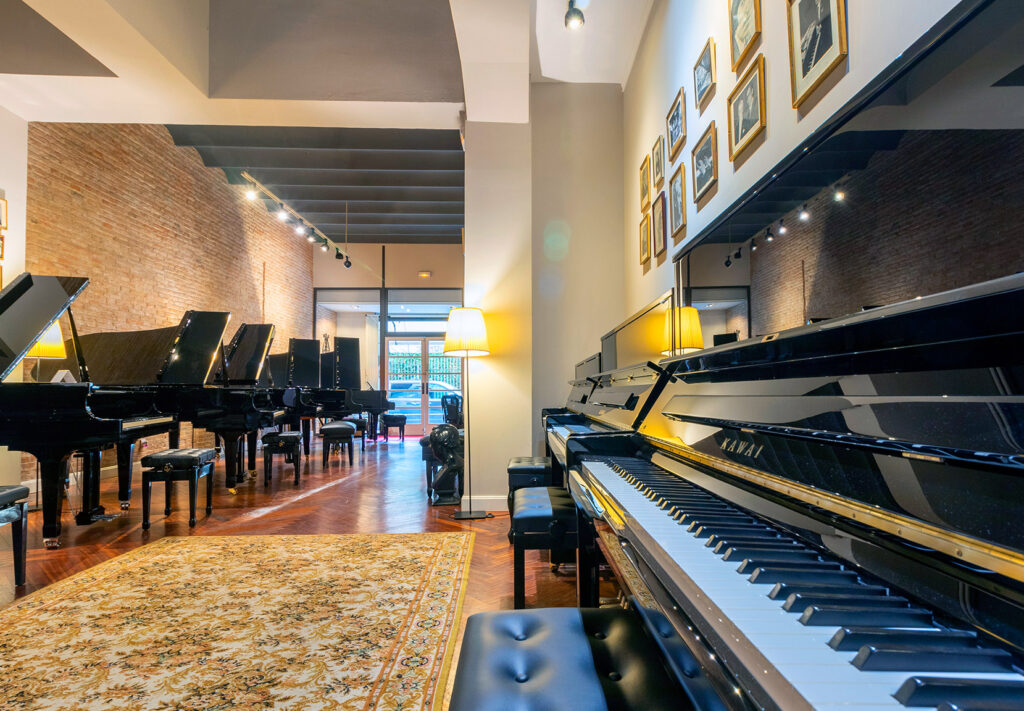
At Jorquera Pianos we have been surrounded by these terms for generations, and we know that what truly clears things up is having the instrument in front of you. In our Barcelona showroom, you can closely examine every part, hear the differences, and ask whatever you like.
Talk to us