The best way to get it right when buying a piano is to start with four questions: how much you want to invest, what level you play at, how much space you have, and what you will use it for. With those four answers, the choice between a digital, upright, or grand piano becomes quite clear.
The perfect piano in the abstract does not exist: the one that fits your situation does. This guide goes through each criterion so you know which piano to buy without relying solely on price.
Before choosing: four questions
Buying a piano is a decision that stays with you for many years. Before looking at specific models, it is wise to be clear on four things: the budget, the level you play at, the available space, and the use you will give it. Each of these will rule out or reinforce a type of instrument.
If you are still unclear about the differences between a grand, an upright, and a digital piano, start with our guide on piano types. Here we assume that point is covered and go straight to the decision.
Which piano to buy according to your budget
The price of a piano spans a very wide range, so it helps to think in terms of brackets rather than absolute numbers.
Tight budget
In the most accessible bracket, a digital piano with a weighted keyboard or a studio upright are the best options. They allow you to start off on the right foot without committing to a massive investment.
Mid-range
This is where the well-branded acoustic upright comes in, delivering a clear leap in sound and touch. This is also the bracket where pre-owned options open up access to superior instruments.
High-end
A grand piano or a premium upright sits at the top end. It requires the largest investment, but also offers the greatest long-term potential for anyone playing seriously.
According to your level
The level at which you play dictates how much touch response and nuance you will need. Falling short will stall your progress; over-committing to an instrument prematurely doesn’t always pay off.
Beginner
The priority is a full, weighted keyboard. A mid-range digital piano or a studio upright allows you to build technique without developing bad habits.
Intermediate level
A recognized brand’s acoustic upright makes a noticeable difference. The more refined response in touch becomes evident as soon as the repertoire gets more complicated.
Advanced or professional
The grand piano is the benchmark for its dynamics and control. When space doesn’t allow for one, a high-end upright is the closest alternative.
According to the space
Available space rules out options very quickly, so it is wise to measure before falling in love with a model.
Small apartment
A digital or a compact upright resolves this well. The digital adds the advantage of headphones when you share a wall with neighbors.
Spacious living room
A high-end upright fits perfectly or, if the floor plan allows, a baby grand or medium grand piano, which already offers much of the sound of a large grand.
Hall or stage
The grand piano is the instrument designed to fill large spaces with projection and presence.
According to its use
What you will use the piano for changes the equation just as much as your level.
Learning and practicing at home
An upright or digital covers everyday needs. If you practice at different times of the day, the digital wins because of its headphones and adjustable volume. An acoustic with a Silent system solves the same issue without sacrificing the real touch: the mechanics remain those of an acoustic piano, so the tactile response is far superior to that of a digital one, and with headphones on, you can play at any time without disturbing anyone. And it is no minor detail: the better the tool we learn with, the better and faster the learning process will be.
Serious classical study
An acoustic —a tall upright or a grand— better supports technical evolution and tonal work.
Composition, recording, or live performance
A digital piano with good connectivity and audio output fits best: portability, MIDI, and direct recording without having to build a studio around it.
New or pre-owned?
A pre-owned piano is a restored instrument that is tuned and adjusted to play like new. It is the most sensible way to access high-end brands while keeping the investment in check, and it is an option many pianists don’t consider simply because they aren’t aware of it. If you are looking for higher quality than your budget allows in new models, it is worth exploring before making a decision.
Which piano to choose in each case
| Your situation | Recommendation | Why |
|---|---|---|
| I am starting from scratch and want to keep costs down | Weighted digital or studio upright | Full keyboard to build technique without overspending |
| Serious learning at home | Good brand acoustic upright | Real sound and touch in a manageable size |
| Advanced level and I have space | Grand or baby grand piano | Maximum projection, nuance, and response |
| Limited space or varied schedules | Mid-to-high-end digital | Headphones, adjustable volume, and low maintenance |
| I want high-end quality while adjusting the price | Pre-owned acoustic | Premium brands restored below the price of a new one |
| Live performance, composition, or recording | Stage digital or one with connectivity | Portability, MIDI, and direct audio output |
We help you choose
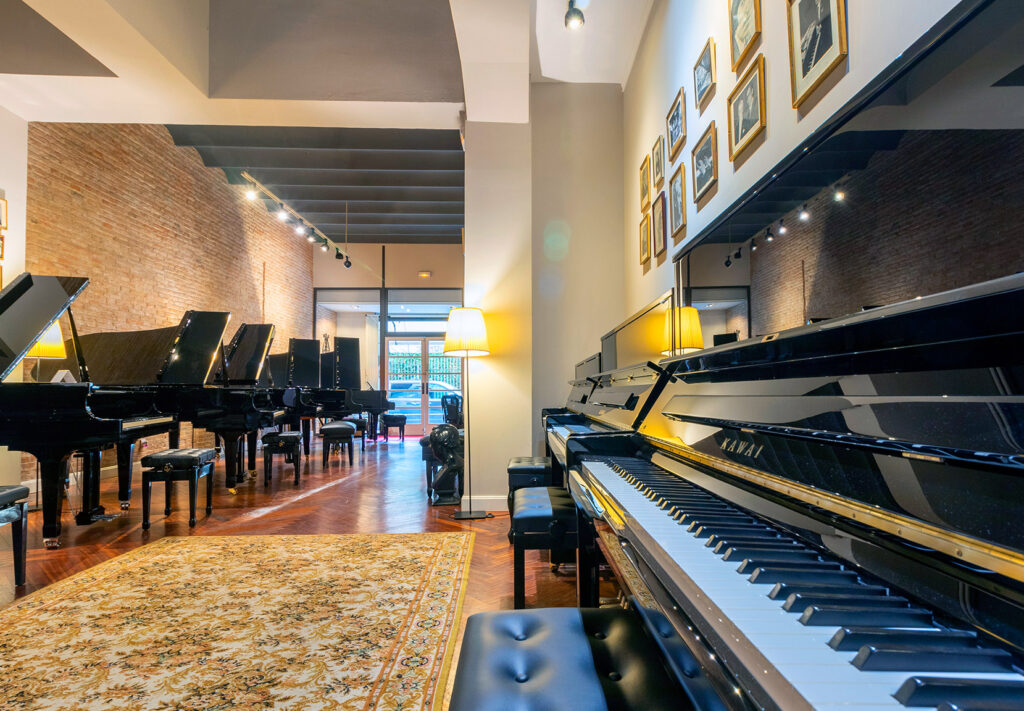
At Jorquera Pianos we have been guiding this decision for generations, and we know that the best way to get it right is to try them out. In our showroom in Barcelona, you can play digitals, uprights, and grands from different brands, compare, and ask questions without rushing.
Tell us your budget, your level, and your space, and we will suggest concrete options.
Talk to us