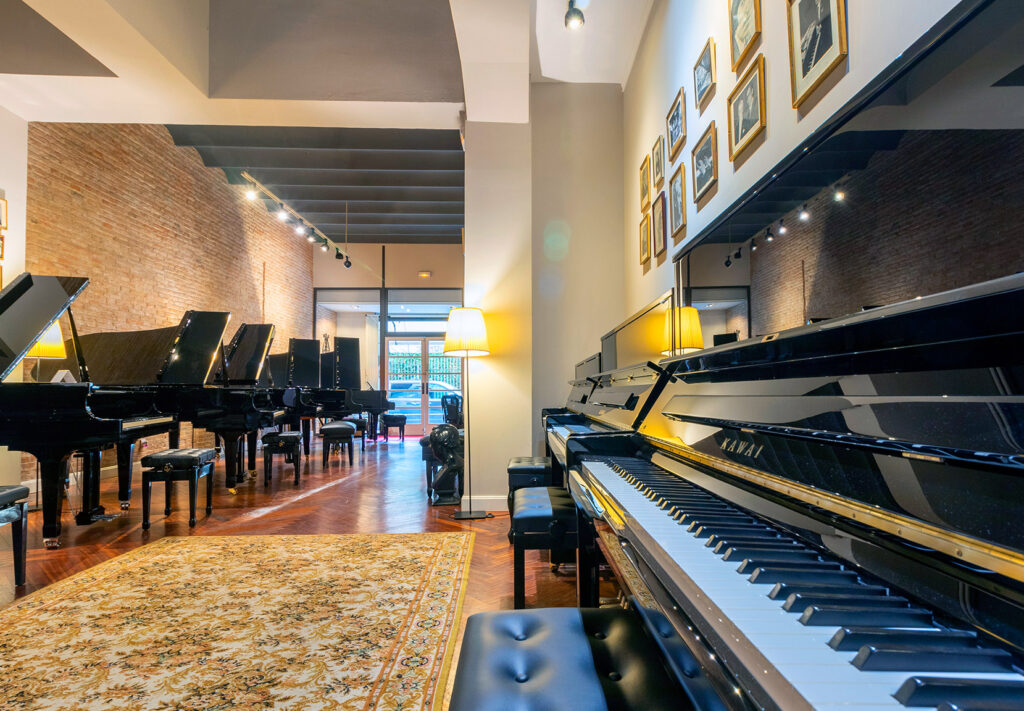
There are three main types of pianos, and the one you choose will shape how you play for years. The grand piano offers the greatest sound projection and the most precise touch, in exchange for space and a larger investment. The upright piano keeps the acoustic mechanism in a format designed for the home. The digital piano reproduces the piano sound electronically, is lightweight, and allows you to play with headphones at any time.
The decision doesn’t just depend on budget. The space you have, your level, and how you plan to use it weigh just as much or more. Here we compare the three types of pianos point by point.
Differences between the three types of pianos
The fundamental difference between a grand, upright, and digital piano is how the sound is generated. In acoustic ones—grand and upright—a hammer strikes a string and the vibration is amplified on the soundboard. In the digital one, there are no strings: the instrument plays back recordings of real pianos through speakers or headphones.
Grand piano
The strings and action are arranged horizontally. It is the format with the largest soundboard surface area, hence its richness of sound and capacity for nuance. Its length varies quite a bit: from just under a meter and a half in the smallest models to nearly three meters in concert grands. The longer it is, the greater the projection and deeper the bass.
Upright piano
The same acoustic principle, but with the strings arranged vertically to save space. It takes up little depth and fits against a wall, making it the standard acoustic piano for the home. Its height usually ranges between just over a meter and a meter and a half, and this height directly influences the volume and quality of the sound.
Digital piano
No strings or soundboard. It generates sound from recorded samples of acoustic pianos, which play when each key is pressed. It requires no tuning, allows you to adjust the volume and connect headphones, and cabinet models integrate into the home just like an upright.
Sound and touch response
This is where the differences become evident. An acoustic piano physically vibrates: the sound has body, resonance, and a response that changes depending on the force of each finger. The grand piano takes this further than the upright, with greater dynamic range and a more sensitive touch, because its mechanism works with the help of gravity.
The digital piano has closed the gap. High-end models reproduce the sound with great fidelity and feature weighted keyboards that mimic the real weight of an acoustic. In entry-level ranges, however, the touch is lighter and the response is less nuanced.
Space and placement
The grand piano needs floor space, and not just because of its length: you have to account for the room needed to open the lid and sit comfortably. The upright solves this by leaning against the wall, with a reduced depth. The digital is the most flexible of the three; some are fixed pieces of furniture and others are portable, easily stored away when not in use.
Maintenance and tuning
An acoustic piano is a living instrument. The wood and strings respond to changes in temperature and humidity, so it must be tuned periodically, usually once or twice a year. The digital piano requires almost no maintenance and does not go out of tune, making it convenient for those who prefer not to rely on a technician.
Price by type of piano
The price range is broad across all three types, but the order usually remains the same. An entry-level digital piano is the most accessible option to start with. The acoustic upright steps up in price, with a wide margin depending on the brand and finish. The grand piano is the largest investment, and its price range is the widest of all: size, brand, and whether it is new or pre-owned all play a role. It is best to inquire for specific prices based on the model, as differences between brands are significant.
Comparison table: grand, upright and digital
| Grand piano | Upright piano | Digital piano | |
|---|---|---|---|
| Mechanism | Acoustic, horizontal strings | Acoustic, vertical strings | Electronic, recorded samples |
| Sound | Maximum projection and nuance | Real acoustic sound, more contained | Faithful reproduction in high-end |
| Touch | The most sensitive and precise | Very good, slightly below grand | Weighted in good models |
| Space | Requires large floor space | Compact, against the wall | Most flexible, even portable |
| Maintenance | Periodic tuning | Periodic tuning | Minimal, no tuning |
| Headphones | No | No | Yes, and adjustable volume |
| Investment | High, widest range | Medium | Most affordable to start |
| Ideal for | Halls, stages, and advanced use | Home, studio, and serious learning | Small spaces and flexible practice |
Which type of piano to choose?
There is no absolute best piano: there is only the one that fits you best. If you have the space, play at a high level, or seek the best possible sound, the grand piano is the benchmark. For a home and serious learning, the upright piano offers the most common balance. And if space is tight, you play at varying hours, or are starting from scratch, a digital piano with weighted keys is more than sufficient.
Many pianists transition from one to another over the years. That’s why it’s worth considering not only the present moment, but also how you want your playing to evolve.
Try before you decide
At Jorquera Pianos, we have been helping people choose the right piano for generations, and we know the best way to decide is to play. In our Barcelona showroom, you can test all three types, compare brands, and resolve doubts with someone who knows each instrument inside out.
Tell us about your space, your level, and what you’re looking for, and we’ll guide you with no obligation.
Talk to us